Ethiopia was in 1934 one of the few independent states in a European-dominated Africa. A border incident between Ethiopia and Italian Somaliland that December gave Benito Mussolini an excuse to intervene. Rejecting all arbitration offers, the Italians invaded Ethiopia on October 3, 1935.
The Fascist Italy occupy the new country, considered by Mussolini’s architects to be a ‘virgin territory’ waiting to be transformed into Italian territory, was nothing less than the articulation of the ultimate ability to plan a society.
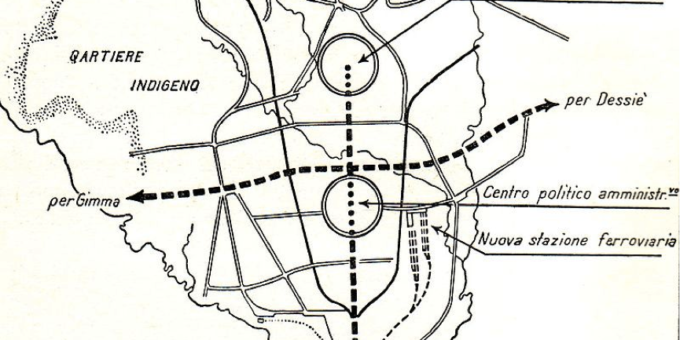
The implementation of the master plan that was prepared by Guide and Valle in 1936, which was based on the policy of segregation, had to begin with the eviction of Ethiopians, who had settled and lived there for more than 50 years, in areas now reserved for Italians. Hence the Italians between 1937 and 1940, according to Pankhurst (1986), passed an expropriation order against 480 proprietors with 953 houses in 1937, 1,239 proprietors with 1,407 houses in 1938, 1,418 proprietors with 1,629 houses in 1939 and 1,290 proprietors with 1,420 houses in 1940, i.e. a total in four years of 4,427 proprietors with 5,409 houses.
By the middle of 1937, according to Poggiali (as cited in Pankhurst, 1986), “more than 10,000 blacks, almost a ninth of the colored population” had been evicted from their houses to the new quarter created for them which is now called Addis Ketema. By the autumn of the following year no less than 20,000 natives where again forced to leave their previous homes and settled in the new quarter.
In addition to this, a further decree was issued in 1938 for the expropriation “for reasons of public health” of native housing that were near to the Italian houses. Thus between 1938 and 1939 specific pieces of land were expropriated causing 528 families to be evicted.
For the relocatees several hundred-model tukuls, each costing around 11,000 lire, were constructed. These tukuls were beyond the means of most relocatees and it was later decided that expropriated persons should be allowed to build their own thatched huts and were allotted plots of land and a subsidy of 400 lire for the construction of the huts (Pankhurst, 1986:38).
One of the major evictions was carried out on the area known as Ras Mekonen Sefer, which is now a days called Casanchis, Menaharia, from areas around No. 6 Police Station and the adjacent land. These areas were cleared from tuckules of “natives” in order to make dwelling areas for upper class Italians.
The type of buildings built over this area were characterized by elaborate apartment blocks illustrating attempts of adapting Roman architecture to the tropical climate. The same type of construction also took place in the southern part of the city for the low cost Italian working class dwelling area known as the Institute delle Case Economiche e Popolare.
Richard Pankhurst (1986:39) argued that the creation of the native quarter was by no means complete, for the Italian plans envisaged many thousand more evictions. However, the fascist collapse brought an end to such plans.
To summarize the Italian had forwarded a master plan for Addis Ababa that was based on racial segregation. The implementation of this plan had to begin with the eviction of Ethiopians who had settled in the area now reserved for the “colonial masters”. Due to this a huge number of “natives” were resettled in the western part of the city known as Addis Ketema. Even if the plan had not been completed due to the fall of the fascist order, it had resulted in dislocating many urban dwellers of that time.
According to Berlan (as cited in Bahiru, 1986) only 20 percent of the plan had been realized by 1941. Some of the important traces that still remains are the south ward shift of the business center. The foreign ministry, the National Palace and the E.C.A building are three “somewhat faint echoes “of Italians intentions to move the political center to the south. Above all the most significant is the creation of Mercatto and the surrounding Ethiopians settlements (Bahru Zewde, 1986:14).
Source: Excerpt from Nebiyu Baye (2000). The impact of development-induced urban resettlement schemes on relocated households. MA Thesis, Addis Ababa University.